The EU’s HFC phase-down isn’t a single ban date. It’s a staircase, and each step gets steeper. HFC volumes placed on the EU market fell 37% in a single year after the revised F-Gas Regulation took effect (European Environment Agency, 2025). That drop was just the beginning.
Regulation (EU) 2024/573 replaced the original 2014 rules with an accelerated timeline that runs through 2050. But the sharpest cuts arrive between 2025 and 2036. Each year brings a different restriction: equipment bans in one category, servicing limits in another, quota fees here, production caps there. The result? A patchwork that even experienced contractors struggle to follow. This guide walks through every milestone chronologically, so you can see exactly what’s changing, when it hits, and what it means for your business. For the full regulatory framework covering all refrigerants and equipment types, see our EU F-Gas Regulation 2026 guide.
Key Takeaways
How Does the EU HFC Phase-Down Work?
The EU controls HFC consumption through two parallel mechanisms in Regulation (EU) 2024/573: a quota system (Annex VII) that caps the total volume of HFCs entering the market, and equipment-level bans (Annex IV) that prohibit specific product categories above certain GWP thresholds (EUR-Lex, Regulation 2024/573). The quota does the heavy economic lifting. The bans pick off specific equipment categories.
How does the quota work in practice? Every producer and importer of bulk HFCs receives an allocation measured in CO₂-equivalent tonnes, not kilograms. That distinction matters because a high-GWP gas like R-404A (GWP 3,922) eats through quota almost six times faster than R-32 (GWP 675) for the same weight of gas. The baseline sits at approximately 176.7 Mt CO₂-eq, set from 2015 market data. Each quota period slashes the maximum further down that staircase.
The quota doesn’t directly restrict what contractors buy at the wholesaler. But it works like a funnel: less gas enters the EU market each cycle, so prices rise and availability tightens. Contractors feel the quota through their wallets, not through a badge-check at the point of sale. That’s why understanding the quota schedule is just as important as knowing the ban dates.
2024–2026: Where Are We Now?
The 2025-2026 HFC quota stands at 42.9 Mt CO₂-eq, a 48% cut from the 2023 level of 82.3 Mt (IFRA Refrigeration, 2025). This is already biting. The original 2014 regulation planned a gentler slope. The revised 2024/573 accelerated the schedule, pulling future cuts forward into the present.
Here’s what’s already in effect or arriving this year:
| Date | What Changes | Who’s Affected |
|---|---|---|
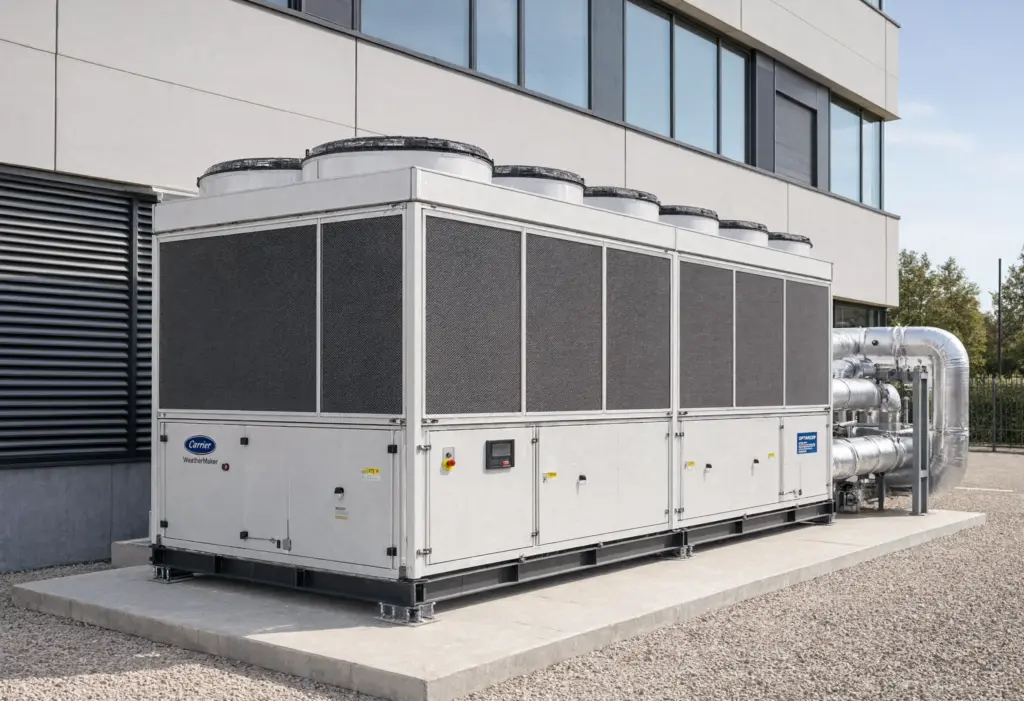
| Jan 2025 | New single-split AC and heat pumps with <3 kg charge: GWP must be below 750 | R-410A (GWP 1,924) banned for new units in this category |
| Jan 2025 | Self-contained commercial refrigeration (plug-in): GWP must be below 150 | R-134a (GWP 1,430) and R-404A (GWP 3,922) banned for new plug-in cases |
| Jan 2025 | Export ban for RACHP systems intended for refrigerants with GWP ≥1,000 | EU manufacturers exporting high-GWP equipment |
| Jan 2025 | New labelling requirements for fluorinated gases (HFCs, HFOs, HCFOs) | All producers, importers, and distributors |
| Jan 2026 | Servicing ban: virgin HFCs with GWP ≥2,500 prohibited for AC/HP maintenance | R-404A and R-507A banned for servicing. R-410A (GWP 1,924) stays legal |
| Jan 2026 | Quota fee of EUR 3 per tonne CO₂-eq introduced (Article 17) | Adds ~EUR 6/kg to virgin R-410A costs |
The immediate impact is clear: R-404A is effectively dead for both new equipment and servicing across the EU. R-410A survives for servicing existing systems, but the quota fee raises its cost floor. Want to know exactly where R-410A stands? Our guide to R-410A’s EU status in 2026 breaks down the virgin vs recycled distinction in detail.
2027: Why Is This the Biggest Turning Point?
The quota drops to roughly 12% of the 2015 baseline for 2027-2029, and a new round of Annex IV bans takes effect that reshapes the residential AC market entirely (EUR-Lex, Regulation 2024/573, Annex IV). January 2027 is the date that forces the industry’s hand on R-32.
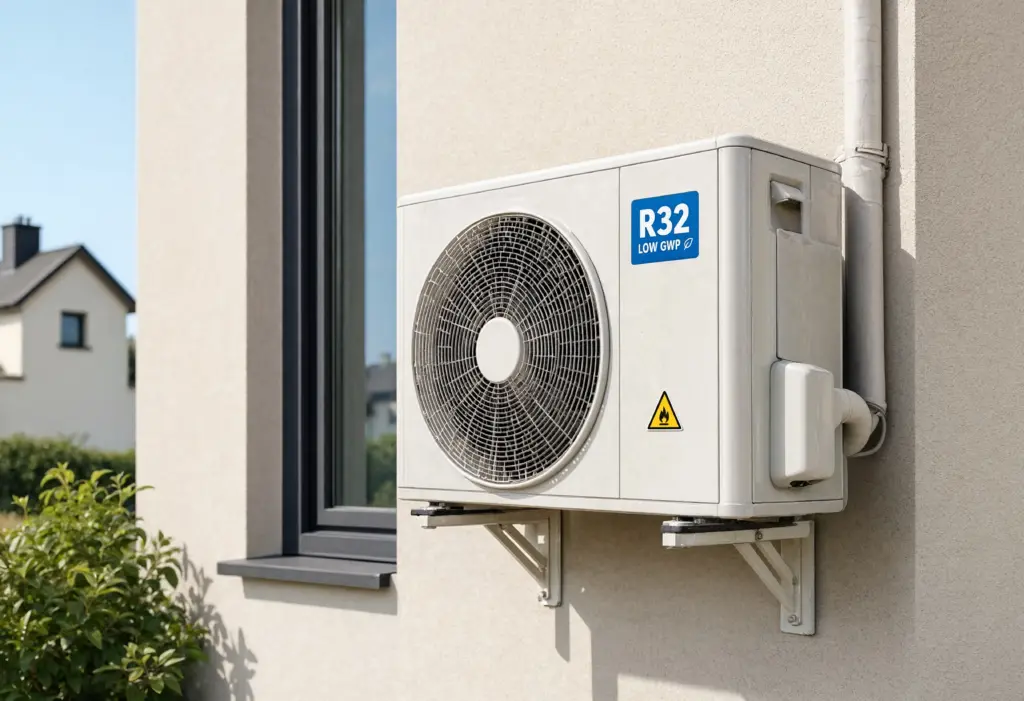
What happens? The GWP ceiling for new split AC systems up to 12 kW and all monobloc units drops to 150. R-32, with a GWP of 675, suddenly can’t go into new small residential units. R-454B (GWP 466) also fails. Only refrigerants below GWP 150 qualify: R-290 (propane, GWP 3) for most applications, or R-32 in larger systems that fall outside the 12 kW threshold.
Why does 2027 matter more than 2025? Because the 2025 bans affected only single splits under 3 kg charge, a narrow slice of the market. The 2027 bans catch everything up to 12 kW, which covers the majority of residential AC and small commercial installations across Europe. If you’re specifying equipment for a project that’ll be installed in late 2026 or 2027, you need to design for the 150 limit now, not the current 750.
There’s a practical concern here too. R-290 systems have charge limits under EN IEC 60335-2-89 that restrict the amount of propane you can use in a single circuit. For larger capacity needs, that means multiple circuits or different system architectures. The 2027 deadline isn’t just a refrigerant swap. It’s a design rethink.
2029–2032: The Road to Near-Zero
From 2030, the EU HFC quota drops to just 5% of the 2015 baseline, roughly 9 Mt CO₂-eq per year. That’s a 95% reduction from where the market started (European Commission, F-Gas Legislation). At 5%, virgin HFC becomes a niche product, expensive and scarce. Here’s the sequence:
January 2029: Hermetically sealed commercial refrigeration and freezing equipment must use refrigerants with GWP below 150. This catches the remaining commercial equipment categories that weren’t covered by the 2022 and 2025 bans. Hermetic compressor manufacturers have largely shifted to R-290 and R-600a (isobutane) already, but this date makes it mandatory.
January 2030: The quota cliff arrives. Virgin HFC supply shrinks to one-twentieth of the 2015 level. For context, the EU HFC market was 82.3 Mt CO₂-eq in 2023. By 2030, the entire annual quota is approximately 9 Mt. The recycled and reclaimed market isn’t optional anymore. It becomes the primary supply channel.
January 2032: The servicing GWP threshold for AC and heat pump equipment drops from 2,500 to 750 (Danfoss, F-Gas Regulation Timeline). This is the date that finally ends virgin R-410A servicing. With a GWP of 1,924, R-410A clears the current 2,500 threshold comfortably. But it can’t clear 750. From 2032, even servicing an existing R-410A system with virgin gas becomes illegal. Recycled and reclaimed R-410A remains exempt under Article 8.
That 2032 servicing deadline is the one most people haven’t planned for. Contractors who stockpiled virgin R-410A for servicing need to know it has a shelf life, not chemically, but legally. After 2032, your only option for R-410A top-ups is reclaimed gas meeting the AHRI 700 standard. Have you started building relationships with certified reclaimers? Now’s the time.
2033–2036 and the Kigali Amendment
The Kigali Amendment to the Montreal Protocol requires developed countries to reduce HFC consumption to 15% of their baseline by 2036 (UNEP, Kigali Amendment). The EU’s 5% target from 2030 overshoots that goal by a decade. So what happens after 2030?
The regulation maintains the 5% quota level through at least 2036. No further step-down is scheduled between 2030 and 2036 because there’s barely anything left to cut. The remaining 5% primarily serves niche industrial applications, legacy military equipment, and specialty uses where no viable alternative exists yet.
Beyond 2036, the trajectory points to a full phase-out. Regulation 2024/573 targets the elimination of virgin HFC use by 2050 (ECOS, F-Gas Factsheet, 2024). By that point, the only HFCs circulating should be reclaimed stock from decommissioned systems. For anyone installing equipment today, that future is already the baseline assumption: natural refrigerants (R-290, R-744, R-717) or ultra-low-GWP synthetics (R-1234yf, R-1234ze) for new builds, and reclaimed HFC for servicing the shrinking installed base.
How does the US compare? The AIM Act follows the same Kigali targets but without the EU’s equipment-level bans. Our 2026 low-GWP refrigerant guide covers the EPA’s approach side by side with the EU framework.
How Will This Affect What You Pay for Refrigerant?
Virgin R-410A already trades at EUR 40 to 48 per kilogram in the EU for 10 kg cylinders (Öko-Recherche for the European Commission, Q4 2025). The new quota fee introduced by Article 17 of Regulation 2024/573 adds EUR 3 per tonne of CO₂-equivalent from January 2026. For R-410A, that works out to roughly EUR 5.77 per kilogram on top of the market price (EUR-Lex, Article 17).
The arithmetic is straightforward: each quota step-down shrinks supply, and shrinking supply pushes prices up. R-32 costs roughly EUR 15 to 22 per kilogram in the EU, less than half the price of R-410A. R-290 (propane) is cheaper still, typically EUR 3 to 8 per kilogram, though equipment costs are higher due to safety requirements for flammable refrigerants. Want to compare replacement options in detail? Our R-454B guide covers the full cost picture for A2L alternatives.
The price signal matters more than the ban dates for most businesses. Nobody had to tell contractors to stop buying R-22 in its final years. The price did the job. Expect the same pattern with R-410A: legal for servicing, but increasingly uneconomical compared to switching to a new R-32 system. The 2032 servicing ban just sets the final deadline for what economics will have already decided.
Frequently Asked Questions
Does the EU HFC phase-down ban all HFCs?
No. The phase-down reduces the total quantity of HFCs placed on the EU market to 5% of the 2015 baseline by 2030, but it doesn’t ban HFCs outright. Low-GWP HFCs like R-32 (GWP 675) remain legal for many applications. Recycled and reclaimed HFCs face no quantity restriction under Article 8 of Regulation (EU) 2024/573. The regulation targets high-GWP gases and virgin supply, not the entire HFC family.
When does R-32 get banned in the EU?
R-32 isn’t banned universally. From January 2027, it’s blocked for new split AC systems up to 12 kW and monobloc units (GWP limit drops to 150). R-32 (GWP 675) exceeds that. But R-32 remains legal for larger systems above 12 kW, and for servicing all existing R-32 equipment. It’s a category-specific restriction, not a blanket ban.
Can I still service existing R-410A systems after the phase-down?
Yes, until 2032. Virgin R-410A (GWP 1,924) clears the current servicing threshold of 2,500. From 2032, the threshold drops to 750, which blocks virgin R-410A. After that date, only recycled or reclaimed R-410A is permitted for servicing, with no end date on reclaimed use under Article 8.
Is recycled refrigerant legal under the EU phase-down?
Yes. Article 8 of Regulation (EU) 2024/573 exempts recycled and reclaimed fluorinated gases from the quota system and from the placing-on-market bans. Reclaimed gas meeting the AHRI 700 standard is functionally equivalent to virgin product. As virgin supply shrinks toward 5% by 2030, the reclaimed market will become the dominant supply channel for servicing existing HFC equipment.
What is the Kigali Amendment and how does it relate to the EU phase-down?
The Kigali Amendment (2016) to the Montreal Protocol commits developed countries to reducing HFC consumption to 15% of baseline by 2036. The EU’s F-Gas Regulation goes further, targeting 5% by 2030, six years ahead of Kigali. The EU is the most aggressive jurisdiction globally on HFC reduction, serving as the de facto standard that other markets follow.
How does the EU timeline compare to the US AIM Act?
Both follow the Kigali Amendment’s 85% reduction target by 2036, but they get there differently. The EU uses equipment-level GWP bans (Annex IV) plus quota reductions. The US AIM Act relies primarily on production and consumption allowances, with sector-specific rules phased in more gradually. The EU’s equipment bans hit earlier and harder, while the US allows higher-GWP refrigerants in new equipment for longer.
The Bottom Line
The EU HFC phase-down compresses 35 years of transition into a decade. From 2025’s first equipment bans to 2032’s R-410A servicing deadline, every year brings a tighter squeeze. The quota drops to 5% by 2030. Prices will follow the supply curve upward. Recycled gas will shift from niche option to primary supply.
Your action checklist:
- Now: Design all new installations for GWP below 150 (2027-ready), not just below 750.
- Before 2027: Evaluate R-290 equipment options for systems under 12 kW.
- Before 2030: Build a reclaimed R-410A supply relationship for servicing existing systems.
- Before 2032: Plan the replacement schedule for your R-410A installed base.
Every system you install today will operate under rules that get stricter each year. Design for the next deadline, not the current one. Need help identifying the right refrigerant for your next project? Start with the equipment category and work backward from the GWP limit that applies at your planned installation date.