 31 Oct 2026
10 unit bundle of R1234yf
Total 100 kg
HFO refrigerant
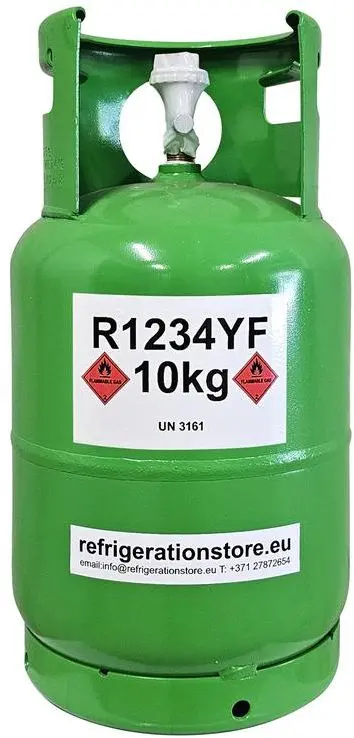
R1234yf is the low-GWP HFO used in the air conditioning of most current passenger cars and vans. We supply it in 10 kg returnable cylinders to certified workshops, vehicle AC specialists and resellers across the EU.
From 690,71 € ex. VAT, per 10 kg cylinder
In stockPrices exclude VAT. t CO₂e is the pack weight multiplied by GWP (AR4).
| Pack | Cylinders | Total | t CO₂e | Price, ex. VAT | Per kg | Order |
|---|---|---|---|---|---|---|
| R1234yf | 1 | 10 kg | 0,04 | 690,71 € | 69,07 € | |
| 3 unit bundle of R1234yf | 3 | 30 kg | 0,12 | 2 026,75 € | 67,56 € | |
| 5 unit bundle of R1234yf | 5 | 50 kg | 0,20 | 3 327,50 € | 66,55 € | |
| 10 unit bundle of R1234yf | 10 | 100 kg | 0,40 | 6 352,50 € | 63,53 € |
R1234yf (2,3,3,3-tetrafluoropropene) is a single-component HFO with a GWP of 4 under AR4 and zero ozone depletion potential. It replaced R134a in new vehicle platforms because the EU MAC Directive set a GWP limit of 150 for car air conditioning. Today it fills the AC circuits of most passenger cars and light commercial vehicles, and it also appears in some buses, trucks and specialist mobile equipment. A small number of stationary chillers and heat pumps are designed for it too.
As a pure fluid it has practically no temperature glide, so pressure and temperature readings line up directly. Automotive systems normally run on PAG oil; always check the oil grade the vehicle manufacturer specifies.
R1234yf is classed A2L: lower toxicity and mildly flammable. It may only be charged into vehicles and equipment designed for R1234yf. Use a service unit approved for R1234yf, identify the refrigerant before you connect, keep ignition sources away and work in a ventilated bay. Never mix it with R134a, and never vent it. R134a service machines cannot be assumed to be compatible.
R1234yf is a fluorinated greenhouse gas covered by Regulation (EU) 2024/573, but it is an HFO, not an HFC, so it sits outside the EU HFC quota system. The servicing bans for gases with a GWP of 2500 or more do not apply to it. Recovery instead of venting, qualified personnel, labelling and records remain mandatory.
Older vehicles built for R134a stay on R134a: R1234yf is not a retrofit gas for them unless the vehicle or equipment manufacturer approves the conversion, with matching service ports, oil and charge quantity. R1234ze is a different HFO used in some chillers and is no substitute for R1234yf in a car. Our automotive refrigerants page groups the gases used in vehicle AC.
Each cylinder holds 10 kg of R1234yf, which is only 0.04 t CO2e (4 x 10 / 1000). An independent garage usually starts with one cylinder on its AC station. Packs of 3, 5 and 10 cylinders suit busy workshops, dealer groups and fleet maintenance, and the price per kg falls with each larger pack. Totals: 30 kg (0.12 t CO2e), 50 kg (0.20 t CO2e) and 100 kg (0.40 t CO2e).
We ship from Fréjus, France and Riga, Latvia: 1-4 working days within France and 2-6 working days to the rest of the EU. Cylinders are returnable and refilled at our Latvian service centre. Sale is restricted to technicians holding the certificate or training attestation required by Regulation (EU) 2024/573, to companies employing such staff, and to resellers. Enter the certificate number and issuing country at checkout; we release the order after the check.
Not as a simple swap. R1234yf is A2L and mildly flammable, and R134a vehicles were not designed for it. A conversion is only acceptable where the vehicle or equipment manufacturer approves it, with the correct service ports, oil and charge quantity. Otherwise service the car with R134a and keep the two gases strictly separate.
No. The servicing bans under Regulation (EU) 2024/573 apply to F-gases with a GWP of 2500 or more, and R1234yf has a GWP of 4. It is also an HFO, so it falls outside the HFC quota. You still have to recover it rather than vent it and work with qualified personnel.
Yes. Use recovery and charging equipment approved for R1234yf, with refrigerant identification and suitability for A2L gases. Do not assume an R134a machine can be switched over. Mixing the two gases contaminates the vehicle circuit and the machine, and the recovered blend can no longer be reused as R1234yf.
Automotive R1234yf systems normally use PAG oil, while some stationary equipment uses POE. The exact viscosity grade and quantity come from the vehicle manufacturer's service data. Check it before topping up oil after a component change, and keep oils for R134a and R1234yf separate in the workshop.
Certified technicians, companies employing certified or trained staff, and resellers. At checkout you choose your basis, enter the certificate or attestation number and the issuing country, and the order is released after the check. EU companies with a valid VAT number are invoiced under reverse charge.
31 Oct 2026
Total 100 kg